


Remember to bookmark this guide and refer back to it as you maintain your pool throughout the sunny seasons!
Maintaining a balanced pool water environment in the sunny Tampa Bay Area is crucial for owners to keep a safe, clean, and enjoyable swimming experience.
The warm climate can lead to faster evaporation and changes in pool chemistry, making regular maintenance crucial.
Check out our step-by-step guide on balancing pool chemicals for both chlorine and saltwater pools, plus some handy tips specific to the Tampa Bay region.
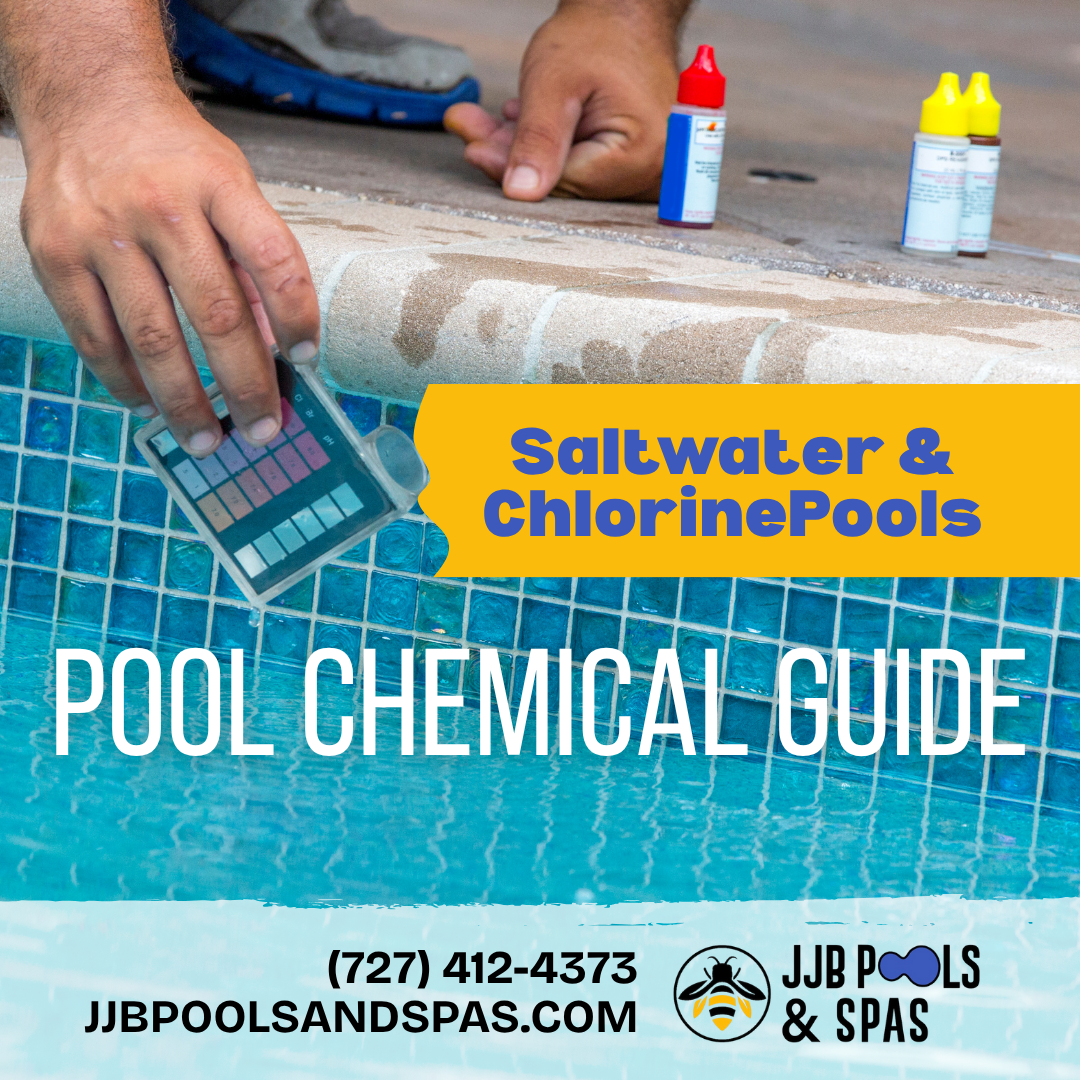
Test the Water
First, get a reliable pool water testing kit that can measure pH, chlorine levels, alkalinity, and calcium hardness. In warm areas like Tampa, you will want to be testing your water at least once a week. This is especially true during the hot summer months when pool usage is at its peak.
Testing for Chlorine Pools
| Free Chlorine | Ideal range is 1-3 ppm |
| Combined Chlorine | Less than 0.5 ppm |
| pH Levels | Target range is 7.2-7.6 |
| Total Alkalinity | Aim for 80-120 ppm |
| Calcium Hardness | Keep it between 200 and 400 ppm |
Testing for Saltwater Pools
| Chlorine Levels | Ideal between 1-3 ppm |
| pH Levels | Should be 7.2-7.6 |
| Total Pool Alkalinity | Maintain a concentration of 80-120 ppm |
| Calcium Hardness | Maintain 200-400 ppm |
| Salt Levels | Test for 2700-3400 ppm, depending on your system |
Adjust pH Levels
For Chlorine Pools
PH is below 7.2? Add sodium bicarbonate (baking soda) to raise it to a level above 7.2.
PH is above 7.6? Use a pH decreaser (sodium bisulfate) to lower it.
For Saltwater Pools
The same steps apply here. Monitor often, as evaporation is high in the Tampa sun!
Balance Alkalinity
Increase Alkalinity
Introduce Sodium bicarbonate when levels are below 80 ppm.
Decrease Alkalinity
Add muriatic acid or sodium bisulfate when the levels exceed 120 ppm.
Chlorine Adjustments
For Chlorine Pools
Raise chlorine levels, by adding liquid chlorine or granulated chlorine.
To shock the pool: To shock the pool, use a shock treatment (follow the package instructions).
For Saltwater Pools
Your saltwater system will generate chlorine; you may need to increase the output setting. Levels are low? Add liquid chlorine to boost it.
Calcium Hardness
For Both Pool Types
- Calcium hardness is low? Add calcium chloride to increase it.
- For high levels, partial water replacement might be necessary.
Regular Monitoring
- Monitor your pool chemicals regularly. Especially important after heavy rains!
- Keep a close eye on the total dissolved solids (TDS) levels. When you have High TDS, it can affect the efficiency of both chlorine and saltwater systems.
Additional Tips for a perfect pool balance in the Florida climate:
Consider the Rain
Watch rainfall patterns. Because heavy rain will dilute chlorine levels, make sure to check and adjust them after storms accordingly.
Sun Exposure
High UV levels can break down chlorine more quickly; consider using stabilizers to protect chlorine levels.
Pool Surface Debris Management
Keep an eye on fallen items from nearby trees and plants, as they can disrupt water chemistry and introduce contaminants into the water.
Balancing your pool chemicals in the hot Tampa Bay climate area involves regular testing and adjustments. Following the steps listed above, you can be sure that your pool remains clean and safe as a result. Happy swimming!
Frequently Asked Questions About Balancing Pool Chemicals
Balancing your pool chemistry keeps the water safe, clear, and comfortable to swim in while protecting your pool equipment. Unbalanced water can lead to corrosion, cloudy water, algae growth, and ineffective sanitization. Regular testing and adjustment help maintain ideal levels for pH, chlorine, alkalinity, and calcium hardness.
You should test your pool water at least once a week, and more often during hot weather or after heavy rain. Frequent testing helps you catch fluctuations quickly and make small chemical adjustments before they become larger problems.
While exact numbers vary slightly, common target ranges include:
Chlorine: 1–3 ppm (safe and effective sanitation)
pH: 7.2–7.6 (comfortable for swimmers and equipment)
Total Alkalinity: 80–120 ppm (stabilizes pH)
Calcium Hardness: 200–400 ppm (prevents corrosion or scaling)
The most effective sequence is:
Test water
Adjust total alkalinity
Adjust pH
Balance calcium hardness
Add sanitizer (chlorine or salt system)
Shock if needed
Following this order helps prevent one adjustment from undoing another.
Yes — heavy rain can dilute chlorine and other chemical levels, while strong sunlight breaks down sanitizer faster. That’s why checking your water after storms or heat waves is crucial for maintaining balance.
Saltwater pools generate chlorine through a salt system, but both pool types require the same core chemical checks (pH, alkalinity, calcium). Salt level testing is an additional step specific to salt systems, and output settings may need adjustment to maintain ideal chlorine levels.
Shocking your pool is often necessary after heavy use, algae outbreaks, or if chlorine levels remain low. It quickly boosts sanitizer levels and helps restore clarity. Follow the product instructions and retest after shocking to ensure levels return to the ideal range.
Printer-Friendly Downloadable Reference Sheet
JJB Pools & Spas provides expert pool maintenance, pool repair, pool resurfacing, pebble surfacing, and pool renovation across Tampa Bay — serving Largo, Palm Harbor, Dunedin, Belleair, South Tampa, Hyde Park, Palma Ceia, St. Pete Beach, Westchase, Odessa, Nine Eagles, Davis Islands & Clearwater Beach, and surrounding areas. Call for a free estimate! (727) 412-4373