


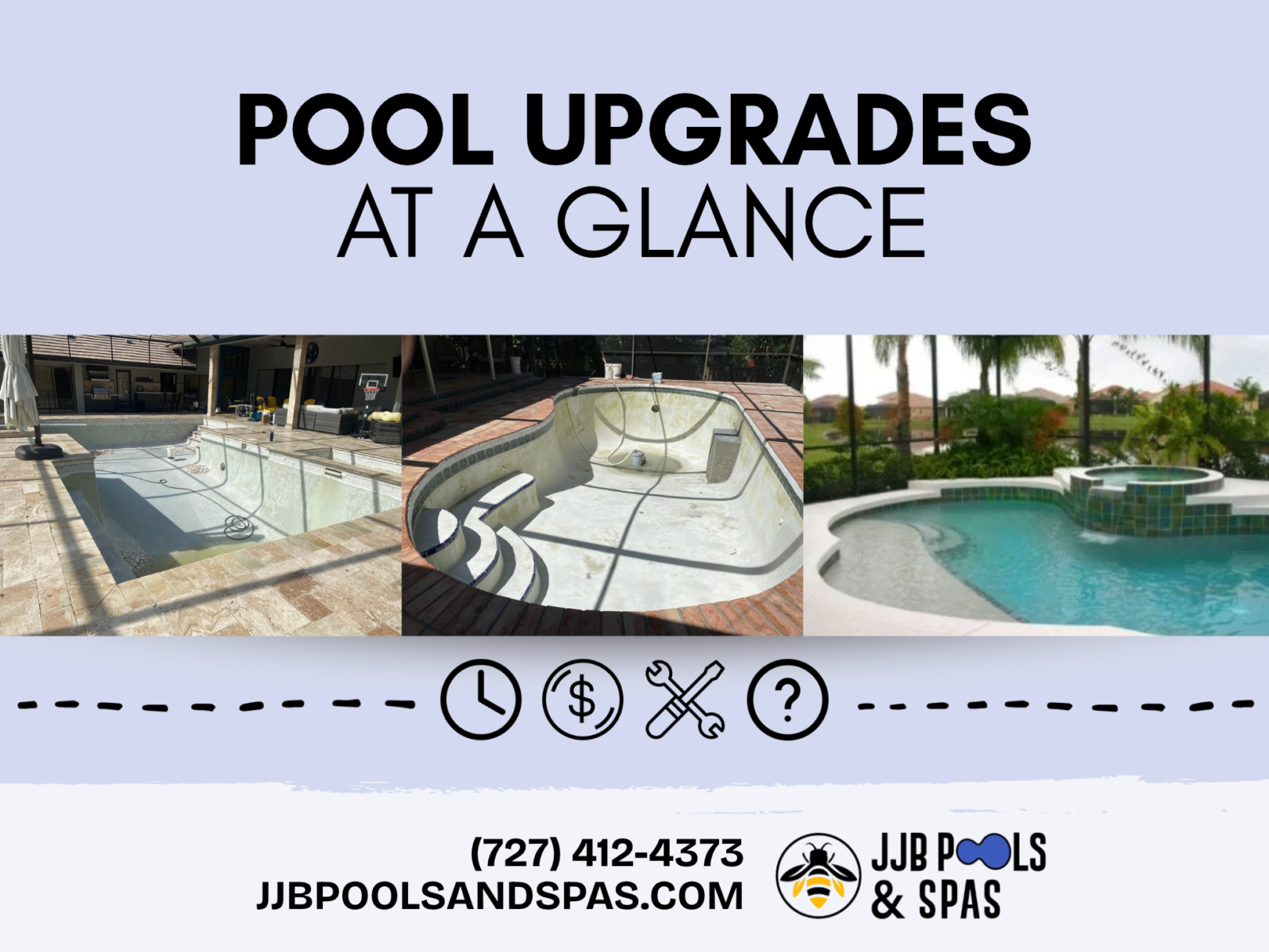
Upgrading your pool doesn’t always mean weeks of construction. Some improvements can be completed in a service visit, while others involve draining the pool, removing materials, or changing its structure.
If you’re deciding where to start, this JJB Pools guide ranks common upgrades from least to most involved, considering time, construction disruption, and relative cost.
These rankings are a starting point for an existing in-ground pool. Your pool’s condition, equipment compatibility, access, and material choices can change the order.
Pool Upgrades at a Glance
The time estimates below are broad planning allowances for straightforward projects—not installation promises. Permits, scheduling, material delivery, repairs, curing, and startup can extend the overall timeline.
| Upgrade | General time allowance* | Construction involved* | Relative cost* |
|---|---|---|---|
| Robotic pool cleaner | Same-day setup | Little to none | $ |
| LED lighting in existing fixtures | Often one service visit | Limited electrical work | $-$$ |
| Variable-speed pump | Often one service visit | Equipment-pad plumbing and electrical work | $$ |
| Pool automation | One visit to several days | Controls, wiring, and possible valve work | $$ |
| Saltwater chlorination | Often one day, plus setup | Equipment-pad plumbing and electrical work | $$ |
| Heater or heat pump | One to several installation days once utilities are ready | Equipment installation; utility work may be needed | $$-$$$ |
| Waterline tile and coping | Several days to a few weeks | Removal, masonry, and water-level adjustment | $$$ |
| Pool resurfacing | Often one to several weeks, including refill and startup | Draining, surface preparation, and new finish | $$$ |
| Full pool-deck replacement | Often several weeks | Demolition, removal, grading, and new decking | $$$-$$$$+ |
| Structural changes or an integrated spa | Several weeks to months | Major construction and system changes | $$$-$$$$+ |
*Timeframes are rough estimates and may vary based on your pool’s condition, site access, existing equipment, weather, and other onsite factors. A more accurate timeline can be provided after evaluating your pool and the scope of work.
Breaking It Down
Add a Robotic Pool Cleaner
A robotic cleaner is one of the easiest ways to change your pool-care routine. Most standalone models require no permanent changes to the pool or its plumbing.
Choose a model suited to your pool’s size, surface, and shape, and check whether it cleans only the floor or also the walls and waterline.
Best for: Making routine cleaning easier with minimal installation work.
Upgrade Existing Pool Lights to LEDs
Replacing compatible existing lights can make a noticeable difference after sunset without a major renovation.
The key word is existing. Replacing a light in a usable fixture is a smaller project than adding lights where there are no openings or electrical connections. Damaged conduits or outdated wiring can also increase the scope.
Best for: Refreshing the pool’s nighttime appearance.
Install a Variable-Speed Pump
A pump upgrade usually keeps the work concentrated around the equipment pad. Installation may involve plumbing adjustments, electrical connections, and programming.
Variable-speed pumps allow speed and operating schedules to match the pool’s needs, creating opportunities to reduce energy use compared with running a single-speed pump. Actual savings depend on the equipment and settings.
Best for: Improving everyday operation, especially when an older pump needs replacement.
Add Pool Automation
Automation can make compatible pumps, lights, heaters, and other features easier to manage from one control system.
This project is relatively straightforward when existing equipment supports the new controls. It becomes more involved when it requires a new panel, additional wiring, valve actuators, or equipment replacement.
Best for: Simplifying control of a pool with several features.
Convert to Saltwater Chlorination
A saltwater conversion generally adds a chlorine-generating cell and circulation controls. It usually involves limited plumbing and electrical work rather than changes to the pool itself.
A saltwater pool still uses chlorine and still needs water testing and balanced chemistry. Check equipment and material compatibility before conversion.
Best for: Changing how chlorine is supplied to the pool.
Add a Heater or Heat Pump
Heating can help make the pool comfortable during more of the swimming season, but installation complexity depends heavily on available utilities.
A gas heater may need a new or upgraded gas line. A heat pump may need electrical upgrades and adequate space for airflow. The best choice also depends on climate and how quickly you want to warm the water.
Best for: Getting more use from the pool during cooler weather.
Replace Waterline Tile and Coping
New tile and coping—the material around the pool’s top edge—can substantially change its appearance.
This moves the project into demolition and masonry work. Removing existing materials may reveal underlying repairs, and new installations need appropriate setting and curing time.
Best for: Updating a dated pool edge or replacing deteriorating materials.
Resurface the Pool
For a concrete or gunite pool, resurfacing replaces the interior finish. The work typically includes draining, preparing the surface, making necessary repairs, and applying the new material.
The job also includes what happens afterward: refilling, balancing the water, and following the finish manufacturer’s startup instructions. The last construction day may not be the first swimming day.
Best for: Renewing a worn interior finish.
Replace the Pool Deck
A full deck replacement affects much of the space around the pool. It can involve demolition, debris removal, base preparation, drainage adjustments, and installation of concrete, pavers, or another surface.
A decorative coating over a sound existing deck is a smaller project and would rank much earlier on this list.
Best for: Addressing a deteriorating deck or redesigning the surrounding pool area.
Change the Pool’s Structure or Add an Integrated Spa
Adding a tanning ledge, changing depth or shape, or building an integrated spa generally requires the most planning and construction.
These projects may involve engineering, permits, excavation, structural work, new plumbing, and equipment changes. Feasibility depends on the existing pool and property.
Best for: Homeowners who want to change how the pool functions and are ready for a substantial renovation.
Choosing the Right Upgrade for Your Pool
Start with the improvement that would make the biggest difference in how you use your pool. Easier maintenance may call for a cleaner or equipment upgrade. A new look may call for lighting, tile, or resurfacing.
If you’re considering several construction projects, plan them together. Coordinating tile, coping, resurfacing, and deck work can help avoid removing or disturbing newly installed materials later.
Thinking about upgrading your pool? Contact JJB Pools to discuss your priorities, budget, and timing—and find out what the work would involve for your pool.
Frequently Asked Questions
What pool upgrades can be completed without major construction?
Adding a robotic cleaner, replacing compatible existing lights, and upgrading equipment are typically among the least disruptive options. Most work happens at existing fixtures or the equipment pad, although plumbing or electrical repairs can add to the scope.
How long does it take to upgrade an existing in-ground pool?
A straightforward equipment replacement may take one service visit, while resurfacing, deck replacement, or structural changes can take weeks or longer. Timing depends on your pool’s condition, site access, weather, materials, and any permits or repairs needed.
What are the most affordable ways to upgrade an older pool?
A robotic cleaner or compatible LED light replacement generally costs less than projects involving demolition or structural work. The most useful upgrade depends on what you want to improve, whether that’s cleaning, appearance, comfort, or everyday operation.
Do you have to drain a pool to install upgrades?
Many equipment upgrades, including pumps, automation, and saltwater chlorination systems, can typically be installed without fully draining the pool. Resurfacing requires draining, while tile and coping work may require lowering the water level or draining, depending on the project.
Is it better to resurface a pool and replace the tile at the same time?
Coordinating resurfacing and tile replacement can help avoid repeated preparation and disruption. If both are on your renovation list, planning them together allows the work to be sequenced properly and may reduce duplicated labor.
What makes a pool renovation take longer or cost more?
Hidden damage, difficult site access, outdated plumbing or electrical systems, utility upgrades, and structural changes can increase both time and cost. Material availability, permits, weather, and curing requirements can also affect the schedule.